
10 Signs It's Time to Replace Your Kitchen Cabinets (And When Repair Still Makes Sense)


Most homeowners notice the signs for months — or years — before they do anything about it. A door that stopped closing right. A drawer face that pulled free during a busy morning. Water staining below the sink that's been there so long it's become part of the kitchen's character. The smell that comes from the back corner of a lower cabinet no amount of cleaning seems to fix.
Kitchen cabinets don't fail dramatically. They fail gradually — and gradually is easy to ignore until the point where ignoring it starts affecting daily life in ways that can't be overlooked.
This guide gives you a clear framework for identifying when cabinets genuinely need to be replaced, when repair or refacing is still the right move, and how to approach the decision with the same clarity you'd apply to any other major home investment.
How Long Should Kitchen Cabinets Last?
The honest answer depends almost entirely on what you have.
Builder-grade cabinets (the standard in Utah homes built between 1980 and 2010) are constructed from particleboard or MDF with laminate or thermofoil facing. With light use and stable humidity, they can last 15–20 years. Under heavy daily use, moisture exposure, or inconsistent climate control — 10–15 years is more realistic.
Semi-custom and custom cabinets built from solid wood or plywood are designed for 25–50 years. Many Utah homes with original solid-wood cabinets from the 1970s are still structurally sound today — they simply look dated. The structure outlasted the aesthetic.
The critical variable: Moisture. Utah's dry climate is favorable — but kitchen environments create localized moisture through cooking steam, dishwasher vapor, and plumbing issues under the sink. The cabinets most likely to fail early are always the ones closest to water sources.
Repair, Reface, or Replace — Understanding the Decision
- Repair addresses a specific, isolated problem — a broken hinge, a pulled screw, a cracked panel. Appropriate when the cabinet box is structurally sound.
- Refacing replaces door fronts, drawer fronts, and hardware while keeping the existing boxes. The right move when boxes are solid, the layout works, and only the aesthetic needs updating. Refacing typically costs 40–60% less than full replacement.
- Replacement is necessary when cabinet boxes themselves are compromised — swollen, molded, structurally unstable, or so inadequate in layout that no surface fix can address the underlying problem.
The signs below will help you determine which category your cabinets fall into.
The 10 Signs Your Kitchen Cabinets Need to Be Replaced
Sign 1 — Water Damage and Swelling
How to identify it: Open the cabinet below your sink and press on the base panel — if it compresses or feels spongy, water has infiltrated the material. Look for dark discoloration, warped panels, separated laminate at the seams, and white mineral deposits (efflorescence) indicating moisture movement over time.
Why it happens: Slow drips from supply lines or drain connections accumulate invisibly over months. By the time visible damage appears, structural compromise has typically been occurring for a year or more. In Utah's older housing stock — particularly Sandy, South Jordan, and Murray homes built before 1995 — original supply lines may be decades beyond their designed lifespan.
When to repair: If the water source has been fixed and damage is limited to staining only on a single panel with no structural compromise, a replacement panel insert may suffice.
When to replace: If the cabinet box itself has swollen, if the base panel compresses under pressure, or if any particleboard or MDF has expanded permanently — the box has failed. Refacing over a structurally failed box is wasted investment.
Practical tip: Inspect every cabinet within 24 inches of a water source. Press firmly on base and lower side panels with a flashlight. Moisture compromise is often found in cabinets adjacent to the visibly damaged one.
Sign 2 — Warped Cabinet Boxes
How to identify it: Look at cabinet doors edge-on. If the door face bows — curving away from the frame at top or bottom — the cabinet box may be warped. Open every door fully: if the four sides no longer form a true rectangle, the structure has moved.
Why it happens: Uneven moisture absorption causes one panel face to expand while the opposite face does not, making it curve. Kitchens adjacent to dishwashers are particularly vulnerable — the side-panel of the nearest cabinet absorbs exhaust moisture over years.
When to repair: Minor door sagging caused by a worn hinge (not box warping) is repairable with new adjustable soft-close hinges.
When to replace: If the box itself is no longer square — if you see daylight at the door-to-frame contact — no hinge adjustment corrects the structural problem.
Sign 3 — Doors That Won't Close or Stay Aligned
How to identify it: Close every cabinet door. Do any fail to close flush? Bounce back open? Show a visible gap at top or bottom when shut? Does any door misalign with the drawer below it?
Why it happens: Two distinct causes with different resolutions: hinge wear causes individual doors to sag (repair); box racking — the entire cabinet structure shifting out of square — causes alignment failures across multiple doors simultaneously (replacement).
When to repair: A single door with a worn hinge is a $20–$80 fix. Soft-close hinges with multiple adjustment axes can often realign a misbehaving door without structural work.
When to replace: If three or more doors across the kitchen are misaligned, or adjusting one door creates a new problem elsewhere, the cabinet boxes have racked. No hinge adjustment resolves a structural shift.
Sign 4 — Mold or Mildew Inside the Cabinet
How to identify it: Inspect every cabinet's back wall, base, and corners with a flashlight. Mold presents as dark spots (black, dark green, or gray), fuzzy growth, or staining that won't wipe clean. Mildew is lighter in color with a distinctive musty smell.
Why it happens: Mold needs moisture, organic material, and darkness — kitchen cabinets provide all three when a moisture source is present. In Utah homes built before 2000, many cabinets have paper-faced MDF or raw particleboard interiors that support mold growth readily once moisture infiltrates.
When to repair: Surface mildew on a sealed, hard interior surface (melamine or thermofoil) can sometimes be treated if the moisture source is eliminated — with professional mold assessment, not DIY surface cleaning.
When to replace: Visible mold on raw wood, MDF, or particleboard means the mold is embedded in the material. Surface cleaning is not remediation. The material must be removed — non-negotiable in homes with children or immunocompromised individuals.
Health note: The priority is eliminating the moisture source before installing new cabinets. Installing new cabinets over an active moisture problem replaces the symptom, not the cause.
Sign 5 — Peeling Laminate or Thermofoil
How to identify it: Check edges of drawer fronts, the bottom of upper cabinet doors, and any corner where door face meets edge. Peeling shows as lifted corners, bubbling surfaces, or a visible gap between the laminate edge and the substrate.
Why it happens: Laminate and thermofoil facings bond to MDF with adhesive that degrades from cooking heat, UV exposure, or moisture at the edges. Once the edge lifts, moisture infiltration accelerates — it's not a cosmetic problem that stays cosmetic.
When to repair: Very early-stage peeling at a single edge can be re-glued with contact cement. A temporary solution, appropriate only as an isolated occurrence on otherwise sound cabinetry.
When to replace: Widespread peeling across multiple doors, or peeling that has allowed moisture to infiltrate the MDF substrate (causing swelling), indicates system-wide adhesion failure. Refacing over peeling laminate is only viable if the underlying MDF is still flat and structurally sound — which it often isn't.
Sign 6 — Soft, Spongy, or Crumbling Wood
How to identify it: Press firmly with your thumb on the base of lower cabinet boxes, the toekick area, and lower panel sections near the floor. Healthy cabinet material resists pressure. Compromised material compresses, crunches, or feels spongy. In severe cases it crumbles.
Why it happens: Particleboard and MDF disintegrate when they absorb sufficient moisture. The wood fiber matrix breaks down permanently — no amount of drying restores structural strength. This is material failure, not a temporary moisture condition.
When to repair: If the soft area is confined to a single non-structural panel (such as a back wall), panel replacement may be viable while keeping the box.
When to replace: Soft material in any load-bearing component — base, side panels, or face frame — means the cabinet cannot safely hold the weight of a countertop, contents, or doors. Replacement is the only structurally responsible option.
Sign 7 — An Outdated Layout That No Longer Works
How to identify it: Does your kitchen have an essentially inaccessible corner cabinet? Upper cabinets too high for daily use? A layout that separates refrigerator, prep area, and stove so that every step requires crossing the kitchen? No space for a trash pull-out?
Why it happens: Kitchen design philosophy has evolved significantly in 30 years. Kitchens built in the 1980s–1990s prioritized storage maximization over workflow. Many Utah homes from this era feel cramped and inefficient not because they're small, but because the layout was poorly conceived.
When to repair: Not applicable — this is a design problem, not a structural one.
When to replace: If the layout is the primary source of daily frustration and cabinets already show structural decline, replacement with a redesigned layout is the clear answer. If the boxes are structurally sound, the choice becomes refacing (accept the layout) vs. replacement (redesign simultaneously).
Sign 8 — Chronic Storage Problems
How to identify it: Are countertops permanently occupied by items that belong in cabinets but have no space? Have "junk drawers" multiplied? Are pot lids stored separately from their pots? Does the kitchen require rolling carts or standalone shelving units to function?
Why it happens: Older kitchens were designed before the modern range of kitchen contents: stand mixers, air fryers, food processors, large cast iron collections, reusable containers. The cabinet quantity and depth of a 1990 kitchen were adequate for a 1990 household.
When to repair: Not applicable — this is a capacity and configuration problem.
When to replace: If storage deficiency is affecting daily quality of life alongside physical signs from the earlier sections, replacement with modern cabinetry — pull-out shelves, drawer base cabinets, optimized depth, corner solutions — addresses both failures simultaneously.
Sign 9 — Structural Instability
How to identify it: Press upward on the interior base of a lower cabinet while pulling the door frame outward with moderate force. Any flexion beyond trivial indicates compromised connections. For upper cabinets, check where the box meets the wall — is the cabinet pulling away? Are mounting screws backing out of the drywall?
Why it happens: Cabinets are designed to mount to wall studs. Over decades — especially after any remodel work near the wall — cabinets can drift from original mounting points. Door weight adds leverage stress that compounds over years. Upper cabinets that have shifted even slightly are a safety concern when loaded with heavy items.
When to repair: Remounting upper cabinets to studs with proper screws is viable if the box and face frame are undamaged. A specialist can assess whether existing holes are stripped and new attachment points are available.
When to replace: If the face frame is pulling free of the box, if the box is no longer square, or if multiple cabinets show movement — replacement addresses the structural problem at the source rather than patching attachment points that will continue to fail.
Sign 10 — Your Kitchen No Longer Matches Your Lifestyle or Home's Value
How to identify it: Do you avoid having people over because of how the kitchen looks? Has the rest of your home been updated but the kitchen remains visibly from a different era? Are comparable homes in Sandy, Draper, or South Jordan showing kitchens that make yours look dated?
Why it happens: Kitchens age differently from other rooms. Paint refreshes a living room in a weekend; furniture changes gradually. Cabinets are fixed, expensive to change, and visible from every angle in the home's most-used room. When the kitchen no longer reflects the household you've built and the home you've invested in, it affects how you feel in the space every single day.
When to repair: If cabinets are structurally sound and the issue is primarily aesthetic, refacing delivers a visual transformation without full replacement cost.
When to replace: If structural issues from signs 1–9 combine with a design that no longer fits — replacement is the clear answer.
Repair vs. Refacing vs. Replacing — The Complete Comparison
| Criterion | Repair | Refacing | Replacing |
|---|---|---|---|
| Cost | $50–$800 per issue | $4,000–$10,000 | $10,000–$60,000+ |
| Appearance change | None | Significant (doors, hardware) | Complete transformation |
| Layout change possible | ❌ No | ❌ No | ✅ Yes — full redesign |
| Addresses structural issues | ✅ If targeted | ❌ No | ✅ Yes |
| Longevity | Short (patch, not solution) | 10–15 yrs (if boxes sound) | 25–50 years |
| Durability | Existing material | Existing boxes + new faces | New materials throughout |
| Customization | Minimal | Door style and finish | Unlimited |
| Resale value impact | Minimal | Moderate | High |
| ROI | Varies | 40–60% | 60–80% |
| Time required | Hours to days | 1–2 weeks | 4–8 weeks |
| Disruption level | Minimal | Low to moderate | Significant |
| Best situation | Single failure, sound box | Sound boxes, layout works | Structural failure, layout change |
Should You Replace Countertops and Flooring at the Same Time?
The short answer: yes, if the budget allows.
Countertops and cabinets share a structural relationship. When cabinets are replaced, countertops must be removed regardless. The reinstallation labor for existing countertops approaches the cost of new installation — many homeowners find the math close enough that new countertops alongside new cabinets make practical sense.
Flooring is typically installed under or butted to cabinet bases. Replacing flooring after cabinetry requires working around fixed structures. Doing both simultaneously allows a cleaner installation with no visible gap at the toekick and saves significant labor mobilization.
What's Trending in Kitchen Cabinet Design in 2026?
- Shaker-style full-overlay remains the dominant choice in the mid-range — clean, timeless, and available in a wide range of painted finishes.
- Slab-front (flat-panel) doors are growing in Utah's Draper, South Jordan, and newer-construction markets. Contemporary, design-forward, and slightly harder to keep clean in high-use kitchens.
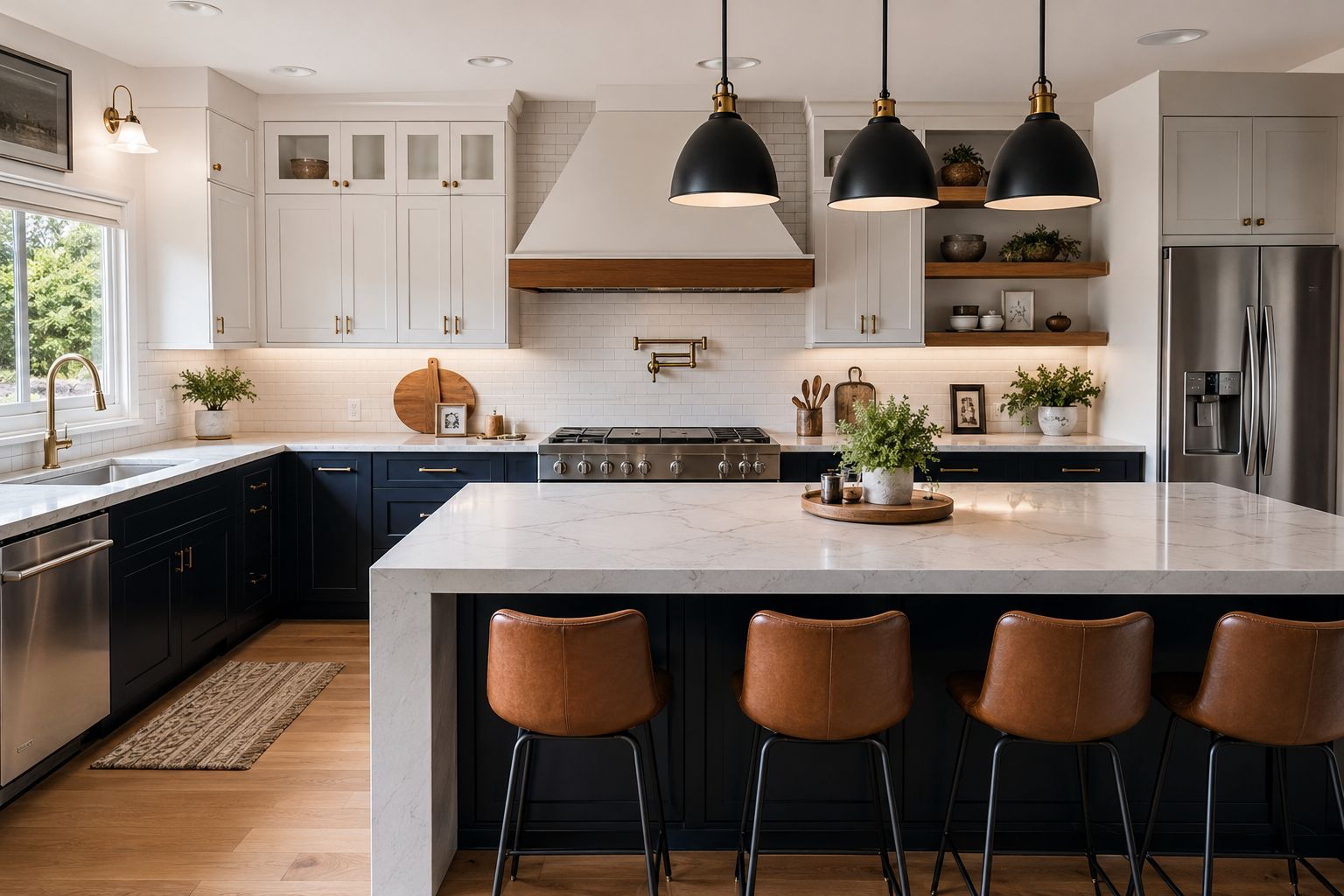
- Two-tone configurations — navy, sage, or charcoal lowers with white or cream uppers — have crossed from trend to mainstream in Salt Lake County. Visual depth with no added installation complexity.
- Deep drawer base cabinets replacing lower door-and-shelf cabinets: the most consistently praised functional upgrade by Utah homeowners post-renovation.
- Integrated storage systems: pull-out spice towers, built-in trash and recycling, under-sink organizer pull-outs, and corner cabinet pull-out systems are increasingly specified at installation rather than added as afterthoughts.
How Much Does Cabinet Replacement Cost in Utah?
Cabinet replacement costs in Sandy, Draper, Lehi, Murray, and the broader Wasatch Front market track closely with national mid-range pricing adjusted for regional labor rates.
| Cabinet Type | Material Cost | Full Kitchen Installed |
|---|---|---|
| Stock (home center) | $80–$200 per linear ft | $3,000–$6,000 |
| Semi-custom | $150–$350 per linear ft | $10,000–$25,000 |
| Fully custom | $300–$600+ per linear ft | $25,000–$60,000+ |
Included in installed cost: Cabinet boxes and doors, hardware, installation labor, removal and disposal of old cabinets, and minor wall preparation. Countertops, flooring, electrical, and plumbing modifications are separate.
How Long Does Cabinet Installation Take?
| Scope | Timeline |
|---|---|
| Cabinet removal and disposal | 1–2 days |
| Cabinet installation (standard kitchen) | 2–4 days |
| Countertop templating (after cabinets) | 1 day |
| Countertop fabrication | 3–7 business days |
| Countertop and finish installation | 1–2 days |
| Total project (cabinets + countertops) | 3–5 weeks from start to finish |
The most common timeline extension is cabinet lead time. Stock cabinets are available within days. Semi-custom ships in 3–5 weeks from order. Fully custom from a local fabricator can run 6–10 weeks. Selecting materials before demolition is scheduled prevents unnecessary delays.
If You Recognized Your Kitchen in This List
Finding two or three of these signs in your kitchen isn't a crisis — it's information. And information gives you options: plan a phased replacement, budget for a full renovation, or at minimum understand what you're working with.
The worst position is the one many Utah homeowners find themselves in: knowing something isn't right, not taking the time to assess it, and then facing an urgent situation — a cabinet box that finally fails, a mold discovery during a plumbing repair, a decision to sell with a kitchen that actively drags the home's value down.
If you recognized your kitchen in this list, the right move is a free consultation with a qualified specialist who can assess the actual condition of your cabinets, give you an honest evaluation of what's salvageable, and help you build a plan that fits your timeline and investment range.
About the Author
Marisa Batista Moreira
Managing Editor | Content Operations Manager at Alta Home Group
Marisa Batista Moreira leads the editorial operations at Alta Home Group, ensuring every article meets high standards of accuracy, clarity, and usefulness for homeowners. Her work focuses on content strategy, local SEO, knowledge management, editorial quality, and AI-assisted content workflows. She oversees the company's educational content to help homeowners make informed decisions about remodeling, renovations, and home improvement projects while maintaining editorial integrity and trusted information.
Ready to Find Out What's Actually Happening in Your Kitchen Cabinets?
Our qualified partner specialists serve homeowners across Sandy, Draper, South Jordan, West Jordan, Riverton, Herriman, Murray, Midvale, Lehi, Orem, Provo, Park City, and the greater Wasatch Front.
Request Your Free Kitchen Cabinet ConsultationRelated Articles
View All
How Much Does Kitchen Remodeling Cost in Utah? (2026 Complete Pricing Guide)
Real kitchen remodel pricing for Utah homeowners — cabinets, countertops, labor, permits, and full project budgets. See what a remodel actually costs in Salt Lake County.
Kitchen Remodeling Mistakes Homeowners Should Avoid
From permit problems to hard water material failures — these are the kitchen remodeling mistakes that cost Utah homeowners the most time and money.

How Long Does a Kitchen Remodel Take? A Realistic Utah Timeline (2026 Guide)
A Utah kitchen remodel takes 6–14 weeks for most mid-range projects — but lead times, permits, and design decisions affect every schedule. Here's the realistic breakdown.