Top Kitchen Design Trends in Utah for 2026

Kitchen design in Utah is moving faster than it has in a long time. Homeowners in Salt Lake City, Draper, South Jordan, and across the Wasatch Front are no longer just looking for a functional upgrade — they're investing in kitchens that carry aesthetic weight, perform at a high level under daily use, and hold their value in a housing market where buyers scrutinize kitchens closely.
The trends shaping Utah kitchens in 2026 are a departure from the all-white, minimalist aesthetic that dominated the previous decade. They're warmer, more layered, more durable, and more intentional. And they're showing up in everything from mid-range remodels in West Jordan and Murray to full luxury renovations in Holladay and Park City.
This isn't a list of trends for the sake of trends. Every item here reflects what experienced remodeling contractors are actually building across the Wasatch Front right now — and what Utah homeowners are choosing when they have the full range of options in front of them.
Trend 1: Two-Tone Cabinet Combinations
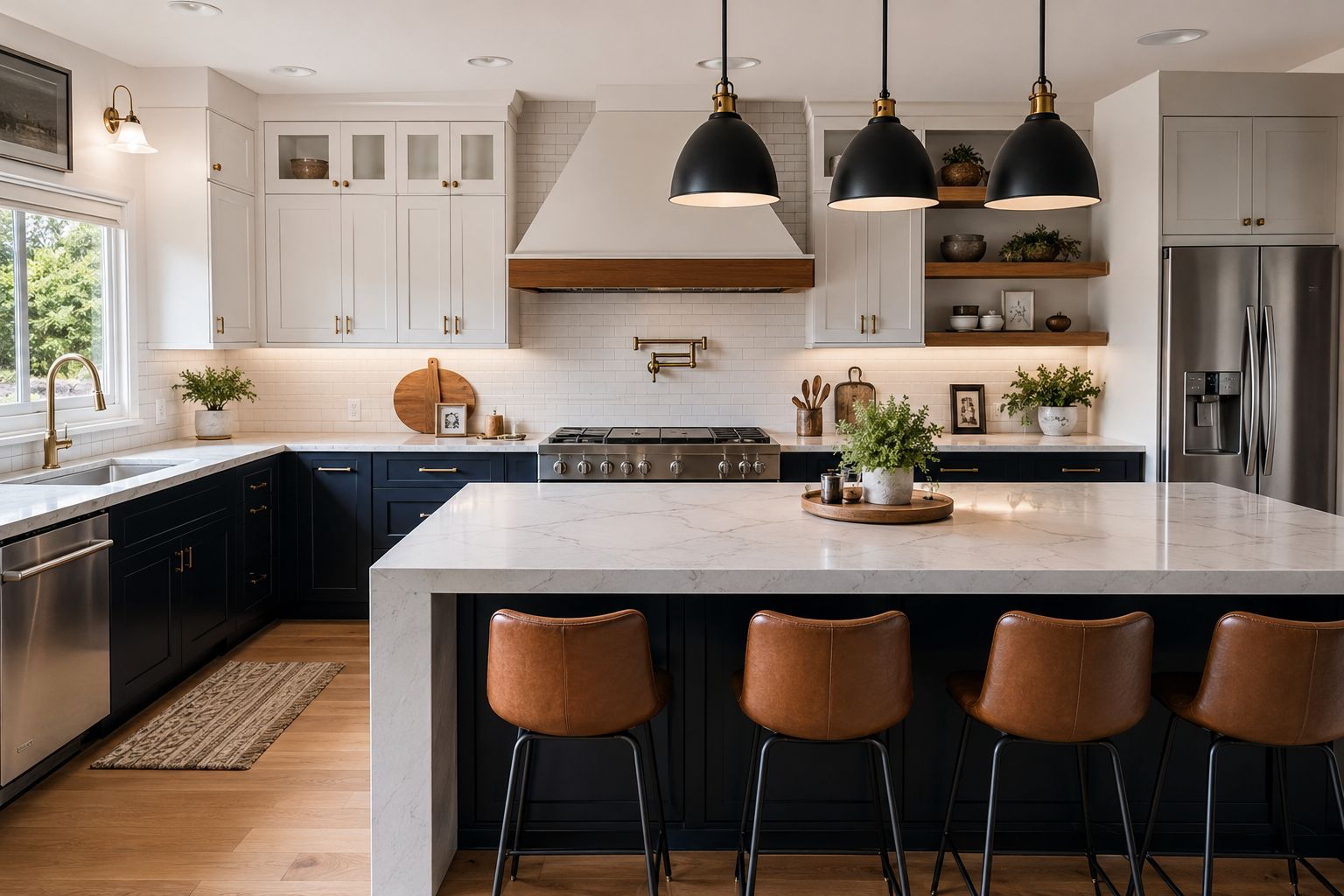
The all-white kitchen is giving way to something more considered. Two-tone cabinetry — typically lighter upper cabinets paired with a bolder, deeper color on the lowers — has become one of the most requested design choices in Utah kitchen remodels in 2026.
What's driving this: The visual logic is strong. Upper cabinets painted white or soft cream keep the kitchen feeling bright and open. Lower cabinets in deep navy, warm sage green, forest green, charcoal, or rich wood tones add grounding and sophistication without darkening the space. The island, when present, typically matches the lower cabinet color or introduces a third accent treatment.
What works in Utah homes: Warm white uppers with deep olive or sage lowers perform well in Draper and South Jordan homes that get significant natural light. Cooler white uppers with navy or charcoal lowers suit the transitional design aesthetic common in newer Herriman and Riverton builds. In Park City and Holladay, where mountain modern design vocabulary dominates, upper cabinets in light warm wood tones paired with dark lower frames create a sophisticated natural palette.
What to avoid: Two-tone only works well when the color pairing is intentional and the finish quality is high. Mismatched undertones between upper and lower colors — a cool white paired with a warm navy — create visual tension that reads as a mistake rather than a design choice.
Trend 2: Quartz and Quartzite Islands as the Kitchen's Focal Point
The kitchen island is no longer a practical addition — it's the design anchor. And in 2026, more Utah homeowners are investing in countertop material specifically for the island that they wouldn't necessarily use throughout the full kitchen.
The approach: Base cabinets get a durable mid-range quartz or granite surface. The island gets the statement material — a premium quartzite slab with dramatic veining, a book-matched marble-look surface, or a waterfall-edge quartz in a bold contrast color. The island becomes the visual center of the room.
Why this works: Concentrating the premium material budget on the island maximizes visual impact without the cost of running luxury stone across every countertop run. A $4,000–$6,000 island slab investment makes a more significant design statement than spreading the same budget across 50 square feet of base and perimeter countertop.
Local context: For kitchen remodels in Cottonwood Heights, Murray, and Midvale, this approach gives homeowners a high-impact kitchen without requiring a full luxury countertop budget. In Draper and South Jordan at the higher price tier, full quartzite or book-matched slab treatments throughout are increasingly the standard.
Trend 3: Hidden Pantries and Integrated Storage
Function is fashion in 2026. The most-requested kitchen upgrade for Utah homeowners planning full remodels isn't a specific material or color — it's hidden storage.
What this looks like:
- Tall pantry columns with interior organizational systems concealed behind solid cabinet doors that match the rest of the kitchen
- Appliance garages — cabinets with retractable doors that hide stand mixers, toasters, and coffee stations
- Deep drawer systems replacing lower cabinet pull-outs, allowing full pot and pan access
- Toe-kick drawers utilizing previously dead space at the base of the cabinet run
Why it matters: Utah families, particularly those in the 3,000–4,500 sq ft homes common in South Jordan, Herriman, Bluffdale, and Eagle Mountain, use their kitchens hard. Built-in organization that keeps appliances and supplies out of sight transforms the daily experience of the space without requiring a larger kitchen footprint.
Installation note: Hidden pantry systems require precise cabinet installation. Floor-to-ceiling pantry columns must be plumb to within 1/16 of an inch for doors and drawers to align and operate correctly. This is where installation quality directly determines whether the "hidden" aesthetic actually works.
Trend 4: Warm Neutrals Replacing Cold White
The cool, stark white kitchen — white cabinets, white quartz, white backsplash, cool gray walls — is fading. In its place: warm neutrals.
What's replacing cool white:
- Warm whites with cream or ivory undertones on cabinets
- Greige (gray-beige) countertops replacing blue-gray or pure white surfaces
- Natural wood tones on islands, open shelving, and accent panels
- Warm beige, terracotta, and earthy clay on walls
- Limestone-look and travertine-look surfaces in backsplash and flooring
Why this is happening: Cool white kitchens photograph beautifully but can feel clinical in daily use. Warm neutral kitchens feel livable, which matters more to buyers who are going to spend real time in the space. In Utah's mountain-adjacent market — particularly in Park City, Holladay, and the east bench communities — the warm neutral palette aligns naturally with the surrounding landscape and interior design context.
Practical consideration: Warm neutral cabinets require more deliberate lighting design than cool white. Under-cabinet LED strip lighting and warm-tone pendant fixtures ensure the warm palette reads as inviting rather than dim.
Trend 5: Statement Backsplashes
The subway tile backsplash isn't going away, but it's no longer the default. Utah homeowners in 2026 are using the backsplash zone as a design opportunity rather than a finishing requirement.
What's performing well:
- Slab backsplashes — running the countertop material up the wall from counter to upper cabinet in a continuous slab eliminates the grout maintenance of tile and creates a seamless, high-end appearance. Popular in quartz and quartzite applications.
- Large-format tile (12x24 or larger) in a staggered or vertical stack pattern, reducing grout line density
- Zellige tile — handmade Moroccan clay tile with irregular texture and color variation, adding warmth and artisanal character
- Fluted or ribbed tile in vertical orientation, adding dimensional texture without pattern complexity
- Marble-look porcelain in full slab height — the visual impact of marble without the maintenance
What's declining: 3x6 white subway tile with white grout. It's not wrong — it's just no longer distinctive. Homeowners who want their kitchen to stand out are choosing something with more visual weight in the backsplash zone.

Slab backsplashes eliminate grout lines entirely and create a seamless surface that reads as luxury regardless of countertop budget.
Trend 6: Mixed Metal Finishes
The rule that all metals in a kitchen must match has been retired. Mixed metal design — pairing two or, in more deliberate applications, three metal finishes — has become one of the defining characteristics of well-designed Utah kitchens in 2026.
Common and effective pairings:
- Matte black + brushed brass: Strong contrast, works with both dark and light cabinet palettes
- Brushed nickel + unlacquered brass: Soft, warm pairing that suits transitional and traditional kitchen styles
- Matte black + brushed gold: More dramatic, suited to two-tone kitchens with deep lower cabinet colors
How to apply this without it looking random: The rule is intentionality, not quantity. Choose a primary finish (typically faucet and cabinet hardware) and a secondary accent finish (typically pendant light fixtures, pot filler, or range hood detail). The secondary metal appears in 20–30% of the metallic surfaces in the kitchen. More than that, and the pairing starts reading as inconsistency rather than design.
Utah-specific context: Matte black has been dominant in new construction across Lehi, American Fork, and Saratoga Springs for several years. Adding a brushed brass or warm bronze accent to a matte black primary kitchen instantly updates the aesthetic without a full hardware replacement.
Trend 7: Open Shelving Done Right
Open shelving has been a kitchen trend for several years. In 2026, the approach has matured — fewer homeowners are replacing entire upper cabinet runs with open shelves and more are using open shelving strategically, as an accent to closed cabinetry.
What's working:
- One or two open shelf sections adjacent to a window or in a corner where natural light enhances display value
- Floating shelves in natural wood or wood-look material on a single wall as a pantry-adjacent display zone
- Open shelf inserts within a larger upper cabinet run, providing variation in the upper elevation without sacrificing total storage
What doesn't work: Full conversion of all upper cabinets to open shelves in a family kitchen with heavy daily use. Open shelves look intentional and curated in design photography. In real households, they accumulate visual clutter within weeks unless actively maintained. The homeowners happiest with open shelving are those who treated it as a curated display element from the beginning, not a storage solution.
Material note: Natural wood floating shelves in white oak or walnut finish are the most requested in current Utah kitchen remodels — they warm the space and pair well with the trending warm neutral palette.
Trend 8: Larger, Multi-Function Islands
Island size has been trending up for several years. In 2026, the conversation has shifted from size to function — specifically, how many distinct functions a single island can serve without visual overload.
What Utah homeowners are building:
- Seating on one side (bar stools, 4–6 seats), prep surface on the other
- Integrated sink with dedicated dish-drying and prep zones
- Built-in microwave drawer below the surface, eliminating the counter microwave entirely
- Charging stations and USB outlets concealed within the island base
- Wine storage or beverage refrigerator integrated into the island end panel
Sizing considerations for Utah homes: In the 2,500–3,500 sq ft homes common across South Jordan, Riverton, and West Jordan, kitchens can typically accommodate a 4x8 or 4x9 foot island with a 42-inch clearance on the work sides. Going beyond this footprint in a standard kitchen layout creates workflow problems. Bigger is only better when traffic flow on all sides is maintained.
Trend 9: Appliance Integration and Concealment
Visible appliances are increasingly a design liability in Utah's higher-end kitchen remodels. Panel-ready refrigerators, dishwasher panels that match cabinet fronts, and built-in column refrigeration units are moving from luxury-only to aspirational-standard.
What integration looks like in practice:
- Refrigerator panels that match surrounding cabinetry, making the refrigerator visually disappear into the cabinet run
- Dishwasher with a custom panel front eliminating the stainless appliance door from the design vocabulary
- Built-in wall ovens and microwave drawers replacing freestanding range in design-forward kitchens
- Under-counter beverage refrigerators integrated into the island end panel
Cost context: Panel-ready appliances carry a premium over standard stainless equivalents. The fabrication and installation of custom panels adds cost. For Draper and South Jordan kitchens in the $650,000+ home tier, integration is becoming the buyer baseline. In mid-range markets, selective integration — panel-ready dishwasher only, for example — delivers meaningful visual impact at a fraction of full integration cost.
Trend 10: Sustainable and Natural Materials
Sustainability in kitchen design isn't yet a primary purchase driver for most Utah homeowners, but it's an increasingly visible tiebreaker. When two options perform comparably in design and function, the one with better sustainability credentials is winning more often.
What this looks like materially:
- Reclaimed wood or FSC-certified wood for open shelving and accent elements
- Quartz countertops from manufacturers with verified low-VOC resin processes
- Recycled glass tile in backsplash applications
- Porcelain tile manufactured with recycled content
- Cabinets certified to CARB Phase 2 compliance or equivalent low-emission standards
Regional context: Utah's strong outdoor recreation culture and proximity to protected public lands makes environmental awareness a more significant factor in design conversations than in markets without that context. Contractors working in Park City and the east bench communities of Salt Lake report that sustainability credentials come up in material conversations more frequently than in suburban markets.
Which Trends Are Right for Your Utah Kitchen?
Not every trend applies to every remodel. The right design choices for your kitchen depend on three variables: your home's price point and neighborhood context, your household's actual use patterns, and your renovation budget.
For mid-range Utah kitchens ($30,000–$60,000 budget):
Prioritize warm neutrals (cabinets and countertop color palette), one statement element in the backsplash zone, and two-tone cabinetry if the layout supports it. Hidden storage organization is high-ROI at this budget. Slab countertops in mid-range quartz or granite deliver premium appearance within a reasonable budget.
For higher-value Utah kitchens ($60,000–$120,000+ budget):
The full range of 2026 trends is accessible. Island statement material (quartzite or book-matched slab), integrated appliances, mixed metals with a deliberate system, and concealed pantry columns are the differentiators in this tier. This budget also supports custom cabinet installation that makes two-tone and hidden storage systems perform at their best.
What stays constant regardless of budget: The quality of the installation. A $25,000 kitchen remodel with excellent installation and thoughtful material choices outperforms a $45,000 remodel with poor installation and trend-chasing decisions every time.
Related Articles
View All
How Much Does Kitchen Remodeling Cost in Utah? (2026 Complete Pricing Guide)
Real kitchen remodel pricing for Utah homeowners — cabinets, countertops, labor, permits, and full project budgets. See what a remodel actually costs in Salt Lake County.

10 Signs It's Time to Replace Your Kitchen Cabinets (And When Repair Still Makes Sense)
Peeling doors, water damage, warped boxes — learn the 10 clear signs your kitchen cabinets need replacing, and when repair or refacing is still the right move.
Kitchen Remodeling Mistakes Homeowners Should Avoid
From permit problems to hard water material failures — these are the kitchen remodeling mistakes that cost Utah homeowners the most time and money.